
The Seven Courts and Shared Power
A Court of Thorns and RosesThis flow follows the political idea of divided sovereignty from the mural to the liberation of Prythian.
increasing Bearing strength in each event
 decreasing
Bearing strength in each eventdecreasingThe Mural's Sevenfold World

The Mural's Sevenfold World
Divided Sovereignty
The Prythian mural depicts Spring, Summer, Autumn, Winter, Dawn, Day, and Night as distinct courts ruled by High Lords.
Fragile Balance
Feyre sees a political system large enough to contain many cultures but vulnerable to one ambitious power. The central mountain hints at the place where that balance has been broken.
The map supplies the scale of the conflict before Feyre knows its history.
The Unequal Captivity
The Unequal Captivity
Different Strategies
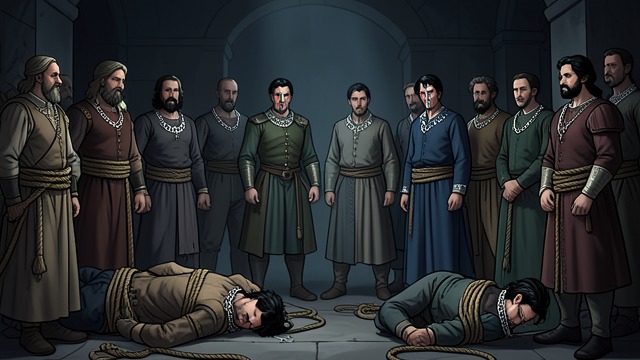
Some High Lords remain trapped beneath the mountain, while others receive limited freedom by swearing allegiance. Rhysand gains greater mobility but becomes publicly degraded.
Common Subjugation
The differences hide a shared condition: every court's power is constrained by Amarantha's control of the High Lords.
The regime succeeds by making resistance look like rivalry. The courts cannot easily coordinate because survival requires individualized compromise.
The Lords at the Trials
The Lords at the Trials
Forced Witnesses
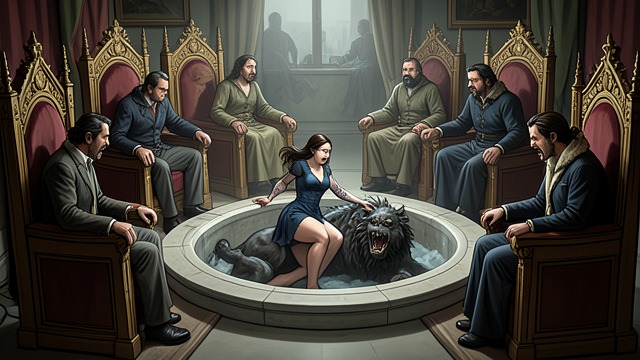
The High Lords watch Feyre's trials while Amarantha turns their political humiliation into entertainment. Their presence demonstrates how completely she has inverted the court system.
Emerging Alignment
As Feyre survives, the Lords' expressions and gestures show that the audience is becoming a coalition of interest rather than a crowd of spectators.
The trials create a shared crisis. Feyre's personal ordeal becomes the point at which the courts can recognize one another again.
The Gift of Power
The Gift of Power
Collective Restoration
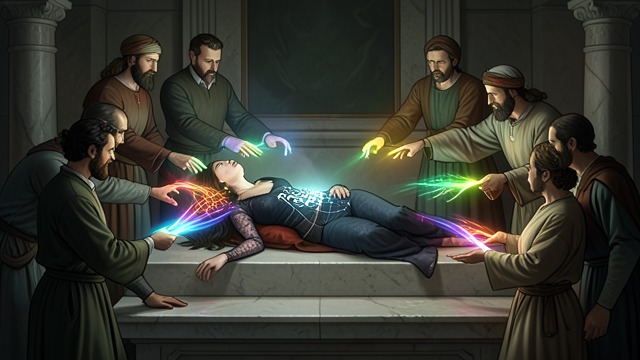
The High Lords place sparks of power upon Feyre's body. Their gifts restore her as High Fae and publicly affirm their shared victory.
New Alliance
The act is not merely healing. It records cooperation among courts that had been divided by fear and punishment.
Power becomes meaningful when it is given collectively rather than hoarded by a single ruler.
A Fragile Political Future
A Fragile Political Future
Open Possibility
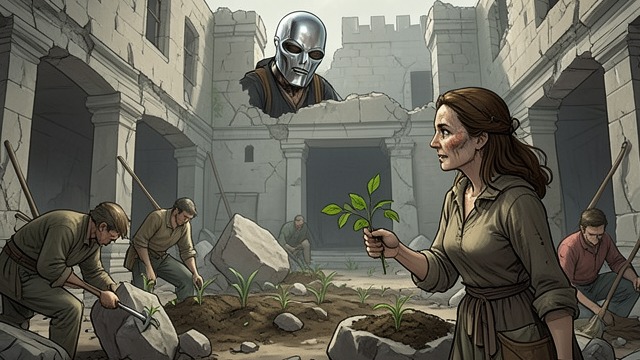
The courts are free, but the King of Hybern remains a threat. The destruction of Amarantha does not end the struggle over human and faerie territories.
Local Reconstruction
Tamlin returns to the Spring Court, where Alis's family and Lucien represent the beginning of communal rebuilding.
The political future is hopeful but unfinished. Shared power must become organized resistance before the next threat can exploit division.
during Feyre's first days in the library
during Amarantha's reign
the first and second trials
after Amarantha's death
the final return to Spring Court
